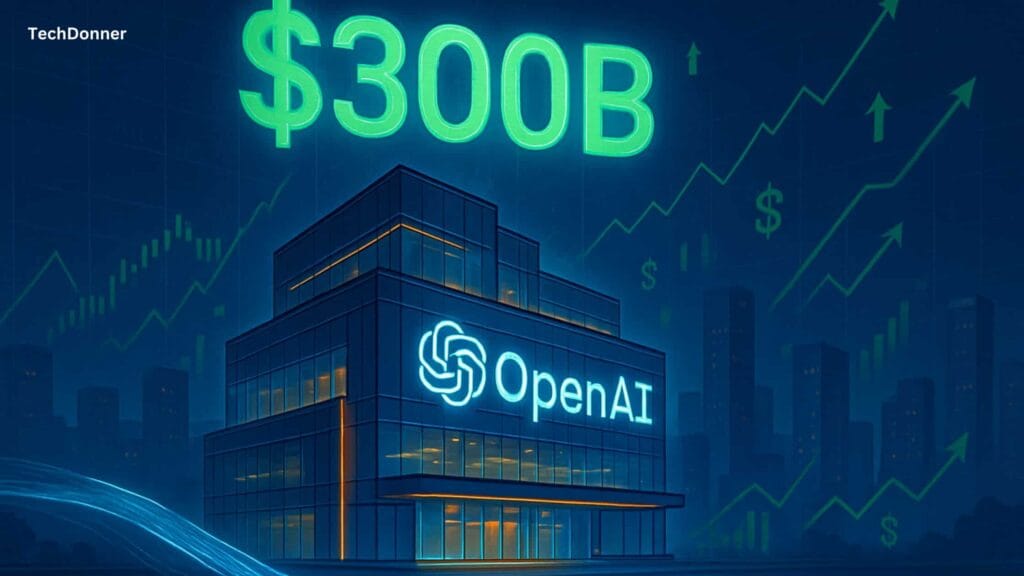
In early August 2025, OpenAI secured $8.3 billion in its latest funding round, bringing its valuation to $300 billion, a staggering figure that underscores confidence in its leadership in the global AI race.
This capital infusion is part of a broader $40 billion financing strategy for 2025, including a $30 billion commitment from SoftBank, contingent on OpenAI completing its transition to a full for‑profit entity by year-end.
Key Highlights
1. Investor Lineup & Oversubscription
- Dragoneer Investment Group led this round with a massive $2.8 billion investment—one of the largest single VC checks in history.
- Other top investors include Blackstone, TPG, T. Rowe Price, Fidelity, Altimeter, Andreessen Horowitz,
Coatue, Thrive Capital, Tiger Global, Sequoia, and others. - The round was five times oversubscribed, forcing allocation cuts even to early backers.
2. Financial Momentum & User Growth
- OpenAI’s annual recurring revenue (ARR) is now around $12–13 billion, with forecasts to exceed $20 billion by the end of the year.
- ChatGPT now boasts over 700 million weekly active users and about 5 million paid business users,
up sharply from earlier in 2025.
3. Funding Structure & Corporate Shift
- The $8.3 billion was raised via convertible notes, allowing investment now while deferring equity issuance until OpenAI completes its governance transition.
- SoftBank’s full $30 billion commitment hinges on OpenAI abandoning its non‑profit oversight structure and becoming a public benefit corporation or similar for‑profit model by December 31, 2025—otherwise, the commitment may shrink to $20 billion.
4. Where the Funds Are Heading
- A major chunk (~$18 billion) is destined for Project Stargate, a joint SoftBank‑Oracle‑OpenAI effort to build U.S. AI supercomputing infrastructure—40 GW by 2030, with potential cumulative investment up to $500 billion.
5. Capital will also power the next generation of AI models (GPT‑5, GPT‑6, open‑weight variants), enterprise product growth, talent retention, in‑house chip R&D, and sovereign compute stacks to reduce NVIDIA dependency.
6. Risks & Strategic Implications
- Despite skyrocketing revenue, the company is still projected to burn around $8 billion in 2025, with profitability not expected until 2029 at the earliest
- The restructuring plan faces legal challenges from Elon Musk and regulatory scrutiny in California and Delaware.
- Competition continues to heat up from Anthropic (~$170B valuation), Google DeepMind, Meta, xAI, DeepSeek in China, and others
Summary Table
| Topic | Details |
| Latest Raise | $8.3 billion (part of a $40 billion plan) |
| Valuation | $300 billion post-money |
| Lead Investors | Dragoneer ($2.8B), Blackstone, TPG, Fidelity, Sequoia, Andreessen Horowitz, others |
| User Metrics | ChatGPT: ~700M weekly users; 5M business users |
| Revenue | $12–13B ARR; projected to reach $20B by year-end |
| Deployment | Infrastructure & compute (Stargate), model research (GPT-5,6), enterprise expansion |
| Corporate Restructure Condition | Must convert to for‑profit by Dec 31, 2025, or face reduced funding from SoftBank |
| Risks | High cash burn, regulatory/legal scrutiny, intense competition |
Final Thoughts
This $8.3 billion raise, coming in months ahead of schedule and massively oversubscribed, marks a turning point for OpenAI. It solidifies its place at the very top of the AI industry, not only in ambition but also in capital and confidence.
The company now has the financial fuel to chase ultra-scaling in infrastructure, model innovation, and enterprise adoption. But with that comes structural risk, legal scrutiny, and mounting pressure to deliver breakthrough results in the competitive AI landscape.