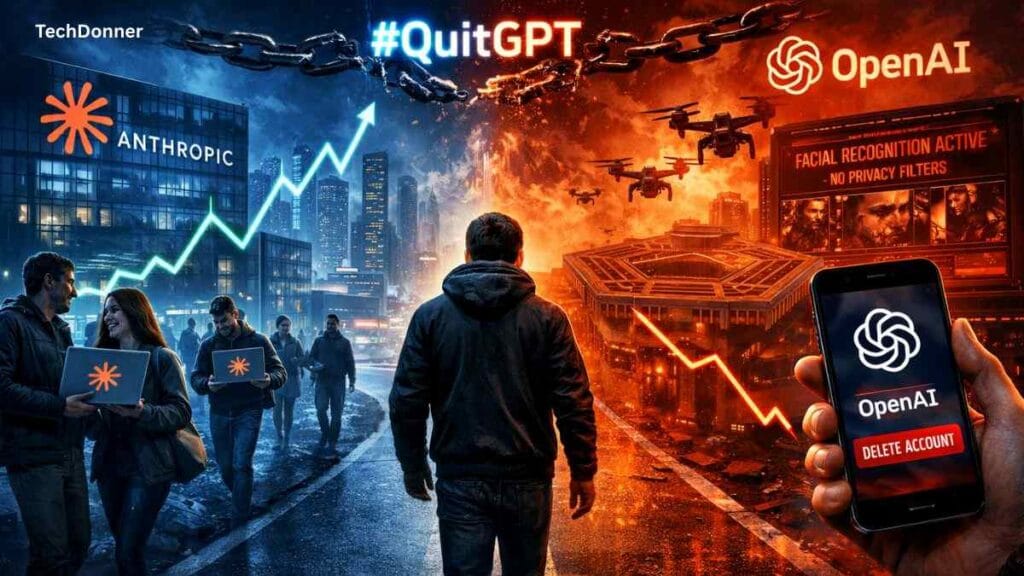
If your social feed is full of people saying they’re “done” with OpenAI, that is the QuitGPT movement, which is trending on the internet. We are currently seeing one of the biggest tech boycotts since the early days of social media. The company claims that almost 2.5 million people canceled their subscriptions and stopped using ChatGPT.
This is all because of a military contract. So, is ChatGPT shutting down, and why is a simple military contract causing millions of people to hit the delete button? Let’s break down the “human” side of this headline.
To understand why people are mad at OpenAI, you first have to look at Anthropic (the makers of Claude AI). In late February 2026, the U.S. government, specifically the Department of Defense (rebranded by the current administration as the Department of War), gave Anthropic an ultimatum: “Remove your safety filters that block us from using AI for mass surveillance and autonomous weapons, or we’ll blacklist you.“
Anthropic said “no”. They stood their ground, and within hours, they were labeled a “national security risk.“
OpenAI did the opposite. Almost the moment Anthropic was shown the door, OpenAI CEO Sam Altman announced they had signed a deal to put their AI on those same military networks. To many, it felt like OpenAI was “swooping in” to take a contract that Anthropic was too ethical to sign.
Why the QuitGPT Movement Is Exploding
It’s not just about the military; it’s about a broken promise. OpenAI started as a non-profit dedicated to “safe” AI for everyone. This deal feels like the final nail in the coffin of that mission.
Here are the real reasons people are quitting ChatGPT:
The “Surveillance” Loophole:
While OpenAI says they won’t allow “mass surveillance,” the contract allows the military to use the AI for any “lawful purpose.” In 2026, privacy laws are unclear. Many users worry that their personal data is being misused by the government’s secret systems.
The Power Shift:
People feel that if the most powerful AI on earth is controlled by the military, it’s no longer a “helpful assistant,” it’s a weapon.
The Choice is Easy:
Unlike Facebook or Amazon, which are hard to quit because they control your social life or your shopping, switching AI is easy. You can move your project to Claude or any local model in five minutes.
The Bottom Line
We are at a crossroads where we have to decide if we want our AI to be a creative partner or a government tool. For millions of users, the answer was to walk away.